
Self-priming magnetic centrifugal pumps combine sealless magnetic drive technology with self-priming hydraulics, enabling safe, leak-free transfer of corrosive chemicals from sumps, underground tanks, and applications where the pump cannot be installed with a flooded suction.
Available in polypropylene (PP) and PVDF, these pumps are engineered for industrial chemical transfer where reliability, safety, and ease of installation are critical. This technical article explains how they work, where they should be used, and what to consider when specifying them in demanding industrial environments.
Self-priming chemical pumpsSealless magnetic drivePP & PVDF constructionCorrosive chemical transfer
In this guide
- What Is a Self-Priming Magnetic Centrifugal Pump?
- How Self-Priming Magnetic Centrifugal Pumps Work
- Why Polypropylene (PP) and PVDF?
- Polypropylene (PP) Version: Where It Fits
- PVDF Version: Where It Fits
- Self-Priming Magnetic vs. Standard Magnetic Pumps
- Advantages of Self-Priming Magnetic Pumps
- Typical Industrial Applications
- Key Technical Considerations for Specifying
- Installation Best Practices
- Working With an Engineering-Focused Supplier
- Conclusion
What Is a Self-Priming Magnetic Centrifugal Pump?
A self-priming magnetic centrifugal pump is a sealless pump that can automatically evacuate air from the suction line and lift fluid from below the pump centerline after initial priming. It combines:
- A magnetic drive (no mechanical shaft seal)
- A self-priming hydraulic design (capable of lifting liquid from a lower level or non-flooded source)
This design is particularly useful in installations where the liquid source is below the pump (underground tanks, sumps, IBCs, drums at floor level), where the system layout does not allow for flooded suction, and where safety and environmental regulations demand leak-free operation with aggressive chemicals.
How Self-Priming Magnetic Centrifugal Pumps Work
Magnetic Drive (Sealless) Principle
Like standard magnetic centrifugal pumps, the self-priming version uses a magnetic coupling between an outer magnet connected to the motor shaft and an inner magnet attached to the impeller inside a static, non-metallic casing. Torque is transmitted through the containment shell, meaning:
- No mechanical shaft seal is required
- The pumped liquid is fully contained within the casing and hydraulic section
- The risk of fugitive emissions and chemical leaks is greatly reduced
Self-Priming Hydraulic Design
Self-priming centrifugal pumps are designed to retain a certain volume of liquid within the casing after shutdown and use this retained liquid to create suction and evacuate air from the suction line during startup.
When the pump starts:
- The impeller agitates the retained liquid, creating a mixture of liquid and air.
- This mixture is discharged while the pump progressively pulls more liquid from the suction line.
- Once air is purged and the suction line is filled, the pump transitions to normal centrifugal operation.
Important practical notes:
- Initial priming is required (the casing must be filled with liquid before first startup).
- After shutdown, the pump must retain enough liquid in the casing to allow subsequent self-priming cycles.
- Installation and piping design must support proper priming and venting.
Why Polypropylene (PP) and PVDF?
Material selection is critical when transferring corrosive and hazardous chemicals. Polypropylene and PVDF are thermoplastics well suited to chemical service, with distinct advantages depending on the media, temperature, and operating environment.
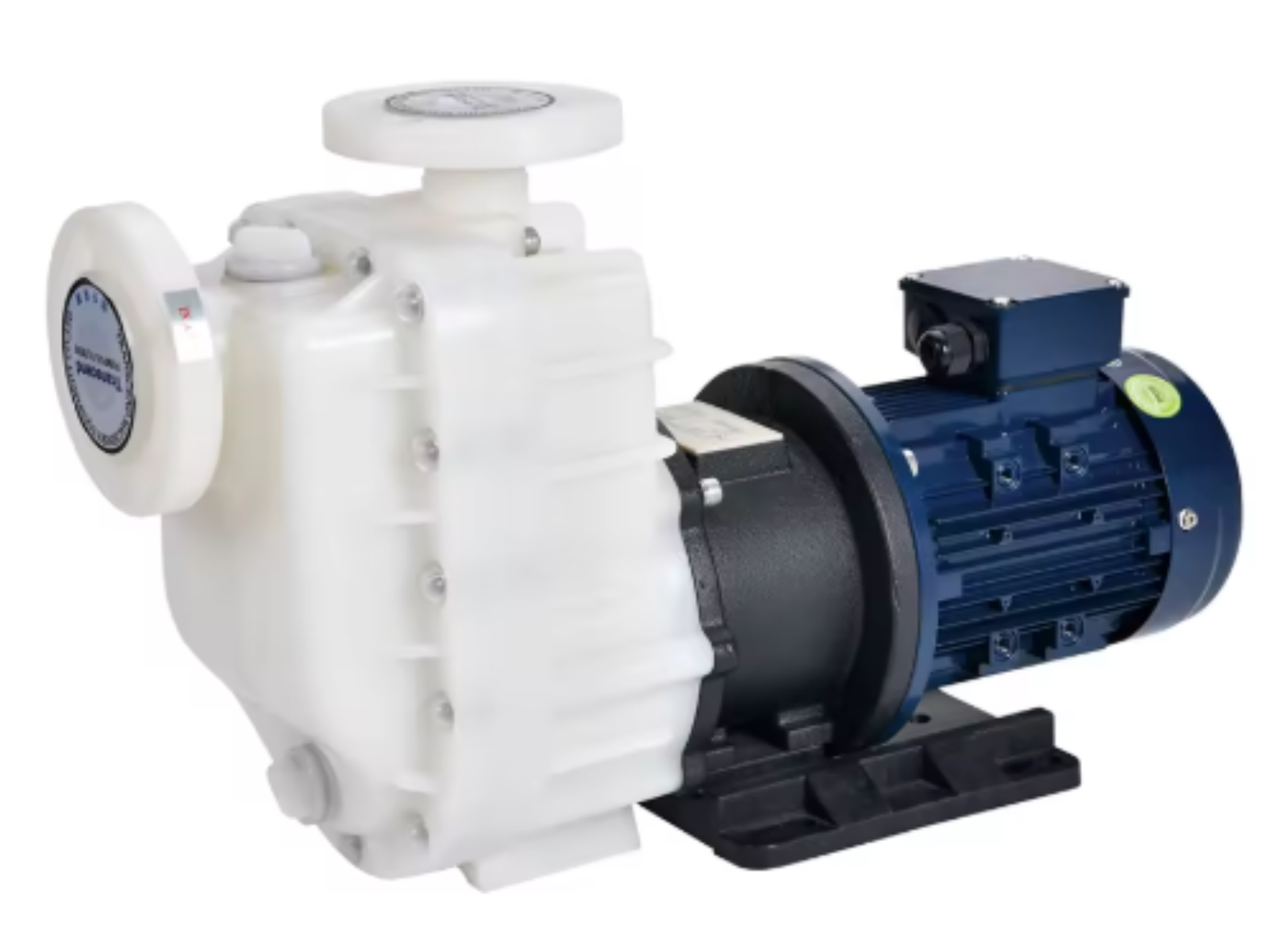
Polypropylene (PP) Version
Polypropylene is an excellent balance between chemical resistance and cost, making it ideal for a broad range of industrial chemicals.
Typical advantages of PP
- Resistant to many inorganic acids, alkalis, and salt solutions
- Cost-effective for general-purpose corrosive service
- Suitable for moderate temperature ranges (application dependent)
- Good mechanical strength for low to medium head and pressure applications
Typical PP use cases
- Transfer from chemical storage tanks and IBCs in water treatment plants
- General industrial chemical unloading and transfer
- Circulation of compatible cleaning and process solutions
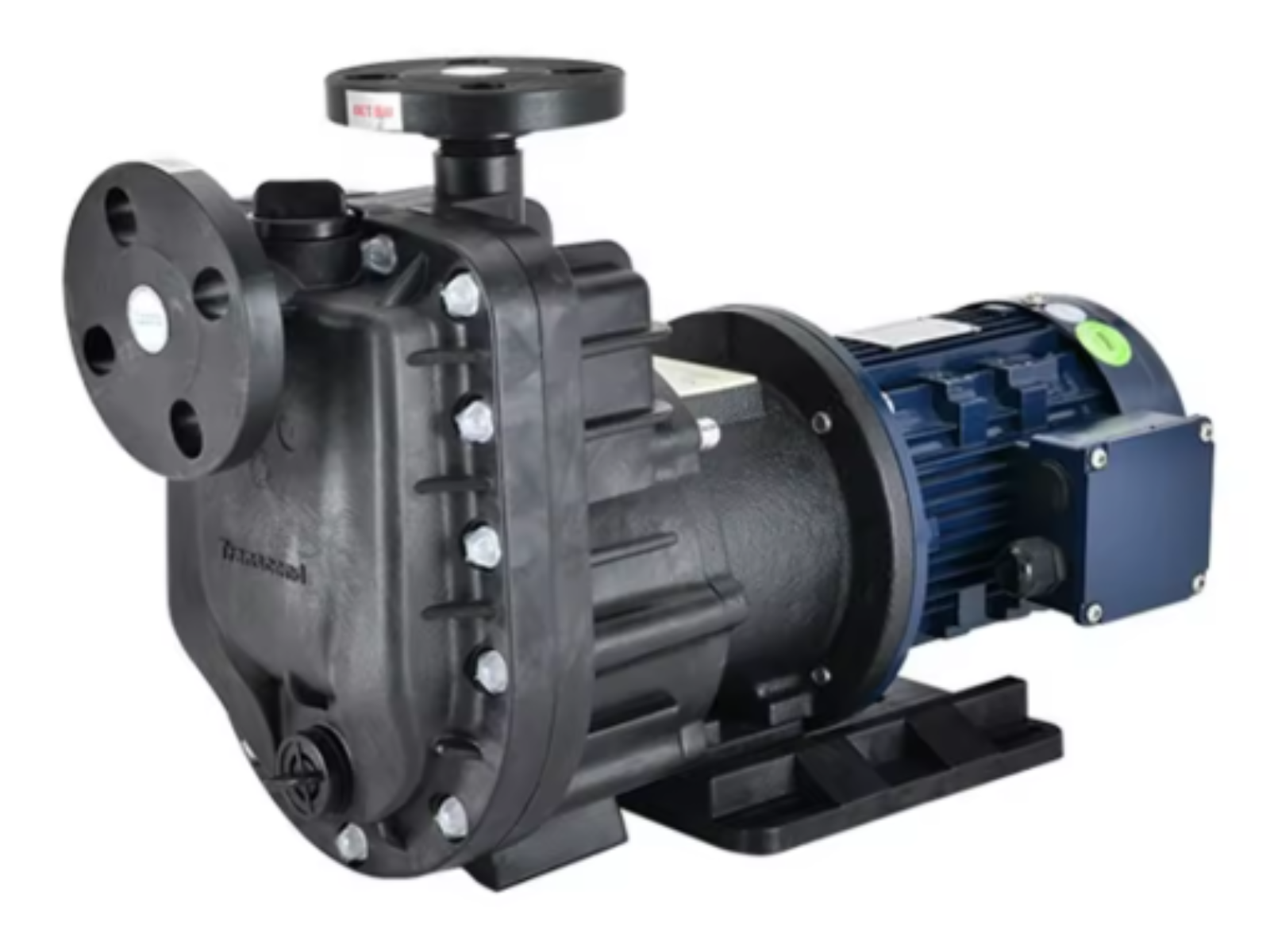
PVDF Version
PVDF (Polyvinylidene Fluoride) is a high-performance fluoropolymer designed for more aggressive chemicals and higher temperatures than PP.
Typical advantages of PVDF
- Excellent resistance to strong acids, oxidizers, and many organic solvents
- Higher temperature capability than PP (within defined limits)
- Better resistance to permeation and stress cracking
- Suitable for highly corrosive and demanding process environments
Typical PVDF use cases
- Transfer of highly corrosive acids and oxidizers
- Chemical processing environments where PP compatibility is insufficient
- Surface treatment, pickling lines, and higher-temperature chemical baths
Self-Priming Magnetic vs. Standard Magnetic Centrifugal Pumps
Both self-priming and standard magnetic centrifugal pumps are sealless and provide leak-free operation. The main differences relate to installation and suction conditions.
Standard Magnetic Centrifugal Pump
- Requires flooded suction (pump inlet always flooded with liquid).
- Typically installed below the tank or at the same level with positive suction head.
- Ideal for applications where piping layout allows gravity feed.
Self-Priming Magnetic Centrifugal Pump
- Designed for non-flooded suction and suction-lift applications within specified limits.
- Can be installed above the liquid level, making layout more flexible.
- Ideal when the pump must be accessible, elevated, or located away from the tank or sump.
When to choose self-priming:
- Liquid source is below pump centerline
- You want to avoid submersible pumps or complex suction arrangements
- You need safe, sealless chemical transfer with easier service access
Advantages of Self-Priming Magnetic Centrifugal Pumps
1) Leak-Free Safety for Corrosive Chemicals
- Magnetic drive eliminates mechanical seals, stuffing boxes, and associated leak paths.
- Ideal for toxic, corrosive, or environmentally hazardous liquids.
- Supports compliance with plant safety and environmental regulations.
2) Flexible Installation
- Handles suction lift (within specified limits) for tanks, drums, and sumps located below the pump.
- Reduces the need to place pumps at floor or pit level.
- Simplifies piping layout in retrofit and space-constrained situations.
3) Reduced Maintenance
- No mechanical seal to replace, flush, or cool.
- Fewer wearing components compared to sealed centrifugal designs.
- Properly applied, can deliver long service intervals with minimal intervention.
4) Enhanced Operational Uptime
- Self-priming capability reduces startup complexity after maintenance or tank changes.
- Once correctly installed and primed, the system can tolerate typical operating cycles without frequent manual intervention.
Typical Industrial Applications
Self-priming magnetic centrifugal pumps in PP and PVDF are used across many industries where corrosive chemical transfer and suction lift are required:
Water and Wastewater Treatment
- Transfer from chemical bulk tanks or IBCs located below the pump
- Loading and unloading from underground or covered tanks
- Dosing skids where a self-priming feed pump supplies metering pumps
Chemical Processing
- Transfer of raw materials from storage to day tanks
- Drum and tote unloading for aggressive chemicals
- Recirculation from sumps, pits, or low-lying vessels
Surface Treatment and Metal Finishing
- Transfer of acid and chemical baths from sumps and low-level tanks
- Circulation and replenishment of pickling and plating solutions
Mining and Mineral Processing
- Handling of corrosive reagents and process chemicals located below grade
General Industrial Utilities
- Chemical transfer for cooling tower and boiler treatment systems
- CIP and cleaning chemicals (where chemically compatible)
Key Technical Considerations for Specifying a Self-Priming Magnetic Centrifugal Pump
To correctly select and size a self-priming magnetic centrifugal pump in PP or PVDF, the following data are essential:
Fluid Properties
- Chemical identity and concentration
- Operating temperature range
- Specific gravity and viscosity
- Presence of solids, abrasives, or gas content
Suction Conditions
- Vertical suction lift (height from liquid surface to pump centerline)
- Horizontal suction line length and number of fittings
- Static and dynamic suction conditions (tank level changes, etc.)
- Need for foot valves, strainers, or non-return valves
Required Performance
- Flow rate (GPM or L/h)
- Total dynamic head (TDH), including static head and friction losses
- System backpressure and required margin for safe operation
Materials of Construction
- PP vs. PVDF selection based on chemical and temperature compatibility
- Elastomer and internal component materials (o-rings, bushings, etc.)
- Required connection standards (ANSI/DIN flanges, threaded connections, etc.)
System Integration
- Motor type and electrical supply (voltage, frequency, phase)
- Control method (on/off, VFD, interlocks with level or flow switches)
- Safety systems (leak detection, temperature monitoring, dry-run protection if applicable)
Installation Best Practices
Correct installation is critical for reliable self-priming performance and long pump life.
Suction Piping
- Keep the suction line as short and direct as possible.
- Avoid unnecessary elbows, high points, and restrictions that can trap air.
- Ensure airtight connections to prevent air ingress, which can impair priming.
- Use properly sized pipe to minimize friction losses and maintain adequate NPSHa.
Priming and Startup
- Fill the casing (and, if specified, part of the suction line) with liquid before first startup.
- Follow manufacturer priming instructions thoroughly.
- Avoid dry running, as magnetic drive pumps rely on liquid for cooling and lubrication of internal components.
Valves and Accessories
- Install isolation valves for maintenance on both suction and discharge sides.
- Use check valves or foot valves where recommended to maintain prime and prevent backflow.
- Consider strainers if there is a risk of solids ingestion (within allowable limits).
Support and Alignment
- Support piping independently to avoid loading the pump nozzles.
- Ensure the pump is installed on a stable, level base.
Working With an Engineering-Focused Supplier
Because self-priming magnetic centrifugal pumps are used in critical and sometimes hazardous applications, collaboration with an engineering-focused supplier is essential.
A qualified supplier should
- Review your fluid data, suction conditions, and system layout
- Confirm material compatibility for PP vs. PVDF and internal components
- Validate self-priming capability for your lift height and piping design
- Provide performance curves and recommended operating ranges
- Advise on installation, priming, and system protection devices
- Support troubleshooting, optimization, and lifecycle planning
Conclusion
Self-priming magnetic centrifugal pumps in polypropylene and PVDF provide a powerful combination of leak-free safety, corrosion resistance, and installation flexibility. By integrating self-priming hydraulics with a sealless magnetic drive, these pumps enable reliable chemical transfer from tanks, drums, and sumps located below pump level— without sacrificing safety or maintainability.
For industrial operators handling corrosive and hazardous chemicals, properly specified self-priming magnetic centrifugal pumps can improve uptime, enhance safety, simplify system layout where flooded suction is not possible, and lower total lifecycle cost through reduced leakage, failures, and downtime.
Need help selecting PP vs. PVDF for your chemical service?
Share your process details—chemical, concentration, temperature, suction lift, required flow, and total head—and our engineering team will recommend the optimal pump configuration and materials within 24 hours.